"Everything Sounds Too Loud!" Why New Hearing Aids Feel Noisy (And When It Stops)
You put your new hearing aids in, and immediately you think: these are broken. The refrigerator sounds like a jet engine. Footsteps on hardwood echo like gunshots. Your own voice booms like you are yelling into a can. Crinkling a grocery bag makes you jump. You take them out, put them back in the box, and think you wasted your money.
This is the single most common experience for new hearing aid users. It is also completely normal. It is not a defect. It is not that the settings are wrong. It is your brain re-learning how to hear, and understanding the neuroscience behind it will help you get through this phase without giving up.
Your Brain Forgot How to Process Normal Sound
Hearing does not happen in your ears. It happens in your brain. Your ears capture sound waves, but your auditory cortex does the actual work of interpreting, filtering, and prioritizing what you hear.
When you have untreated hearing loss for months or years, two critical things happen:
- Your brain turns down the volume on missing frequencies.
When high-frequency sounds stop coming in clearly, your brain eventually stops expecting them. It reallocates that neural real estate to other senses and turns its internal "volume knob" for those frequencies all the way up, waiting for signals that rarely come. When hearing aids suddenly deliver full sound to those frequency ranges, the brain gets hit with input at a volume it has not processed in years.
- Your sound filter atrophies.
People with normal hearing automatically filter out irrelevant sound: the hum of the fridge, the air conditioning, distant traffic, footsteps. You do not consciously hear these things because your brain suppresses them. When hearing loss degrades the incoming signal, your brain loses the ability to separate important sound (speech) from unimportant sound (background noise). It either hears everything or nothing.
This is why everything feels loud. It is not that the hearing aid is turned up too high. It is that your brain's automatic filtering system has been offline, and it needs time to boot back up.
What This Actually Feels Like
Every new user describes the same sensations:
"My house is so noisy!" You did not realize how loud your refrigerator, heating system, computer fan, and fluorescent lights are. People with normal hearing never notice these because their brains filter them out. You are hearing them because your brain has not re-engaged that filter yet.
"My voice sounds like I'm talking in a tunnel." This occlusion effect happens because the sealed ear dome traps bone-conducted sound from your own voice. Everyone hears their own voice partially through bone conduction, but the amplified air-conducted sound is new. Your brain will recalibrate to this within 1-2 weeks for most people.
"High pitches sound sharp and tinny." Those s, f, and th sounds that you have not heard clearly in years are coming through. They sound harsh at first because your brain has forgotten how to process them. These are exactly the sounds that will make speech understandable once your brain adapts.
"Rooms sound echoey." Hard surfaces (tile, wood, glass) create sound reflections that normal hearing suppresses automatically. When you first get hearing aids, these reflections are obvious until your brain learns to ignore them again.
"I can't focus on anything because there's too much sound." This is sensory overload, and it is exhausting. It is the same feeling as being in a foreign country where you do not speak the language—your brain is working overtime to process everything because it cannot yet prioritize what matters.
The Exact Timeline of When It Gets Better
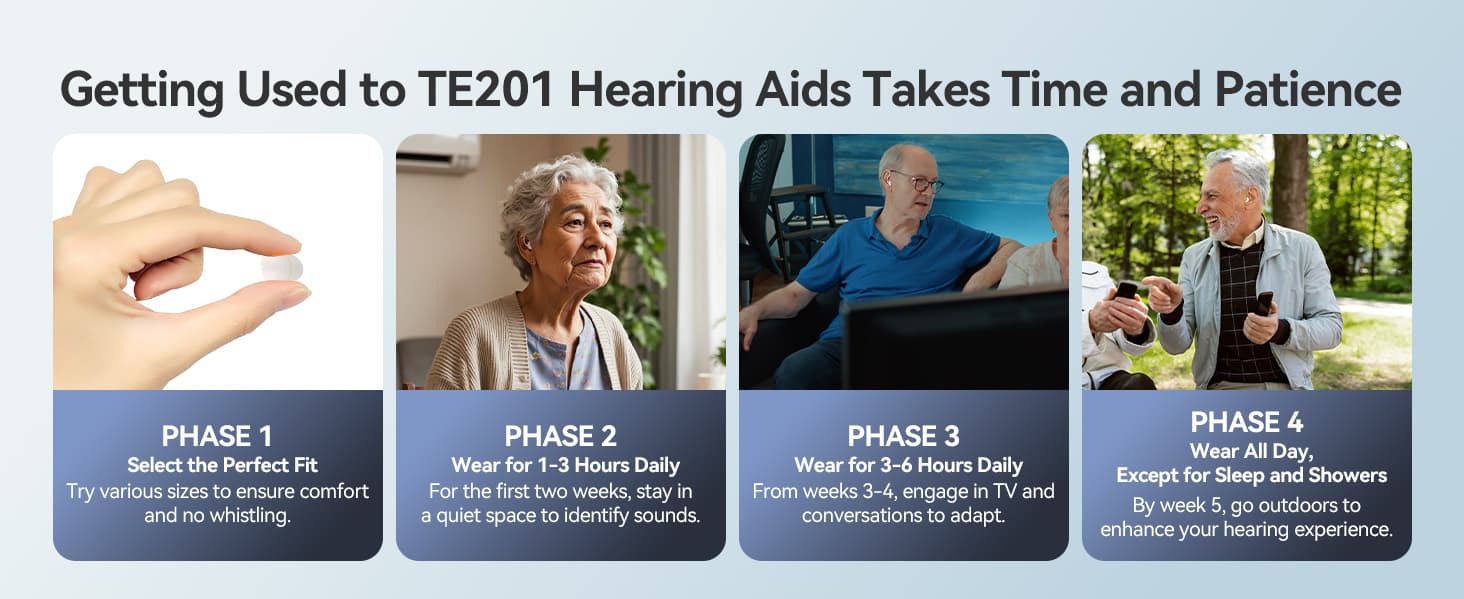
This is not a vague "you will get used to it" promise. Research and clinical data show a predictable adaptation timeline:
Days 1-3: Sensory overload. Almost everything feels too loud. You can only wear the devices for a few hours at a time. You will question whether you made the right purchase. This is the hardest part, and it is the point where most people quit.
Days 4-7: Background sounds start to recede. You will notice one day that you did not think about the refrigerator all morning. Footsteps no longer make you jump. You can wear the devices for longer stretches without fatigue. The occlusion effect (your own voice sounding funny) starts to fade.
Weeks 2-3: Speech becomes clearer. You start realizing you can follow conversations without concentrating as hard. You understand people on the phone better. Environmental sounds feel normal instead of loud. You might forget you are wearing the devices for short periods.
Weeks 4-6: Normal hearing returns. Most users reach the "this is just how sound works" point around one month. You put the devices in and the world sounds natural, not amplified. You can go to restaurants and follow conversations. Taking the devices out makes the world sound muffled and quiet.
Months 2-3: Full adaptation. Speech-in-noise performance continues to improve as your auditory processing sharpens. You do not think about the devices anymore—they are just part of getting dressed in the morning, like glasses.
Research from the National Institute on Deafness and Other Communication Disorders confirms that auditory cortex plasticity continues throughout life. Your brain can and will rewire itself. It just needs consistent input.
How to Make This Go Faster
You cannot eliminate the adaptation period, but you can make it significantly easier:
Wear them every single day.
This is the single most important factor. The brain needs daily, consistent exposure to re-learn how to filter sound. People who wear their devices only occasionally take months longer to adapt, and many never fully do. Even if it feels loud and strange, wear them for at least a few hours every day.
Start quiet, build gradually.
Do not go to a loud restaurant on day one. Start in your quiet home for 2-4 hours a day for the first three days. Then add short outings to quiet stores. Then add restaurants and gatherings after two weeks. This gradual exposure lets your brain build processing skills incrementally instead of hitting it with maximum challenge immediately.
Resist the urge to turn volume down.
It is tempting to turn volume down when things feel loud, but that slows adaptation. Keep volume at a moderate level where speech is comfortable, even if background sounds feel prominent. Your brain needs to hear those background sounds to learn to filter them. If you turn volume down to make background noise go away, you also turn down the speech you need to hear.
Practice active listening.
- Read out loud for 10-15 minutes every day to get used to your own voice.
- Listen to audiobooks or podcasts at a comfortable volume.
- Have intentional conversations in different environments.
- Spend time outside listening to natural sounds.
Active engagement with sound accelerates cortical reorganization much faster than passive wearing.
Choose devices with adaptive processing.
Modern hearing aids are not like the old analog devices that just turned everything up. Quality digital devices like the Retekess TE202 use four separate noise reduction algorithms that gradually introduce sound and smooth harsh frequencies. They do not eliminate the adaptation period, but they make it dramatically more comfortable than devices from even five years ago. Old analog amplifiers made adaptation torturous because they hit you with full volume across all frequencies immediately.
Take short breaks when you need to.
If you feel overwhelmed, take the devices out for 30-60 minutes and let your brain rest. Then put them back in. Short breaks are fine. Just do not give up for the whole day.
When Something Is Actually Wrong
"Noisy" is normal. These symptoms are not, and they mean you need an adjustment:
- Sharp paininstead of mild discomfort. Some tenderness the first week is normal; pain is not.
- Sound remains distortedafter four weeks of consistent wear.
- You cannot understand speech at alleven in quiet rooms after two weeks.
- Tinnitus gets significantly worsewhen you wear the devices.
- One ear sounds dramatically differentfrom the other.
- Vertigo or dizzinesswhen you wear them.
These issues are rare with properly fitted digital devices, but they do happen. Try different dome sizes first—this solves most comfort and sound quality issues. If problems persist, contact the manufacturer or your provider.
The Payoff Is Worth It
People who push through that first week almost universally say it was one of the best decisions they ever made. They talk about hearing their grandkids' voices clearly again, enjoying music, not feeling left out of conversations, and having more energy because they are not straining to listen all day.
That "everything is too loud" feeling is not a problem. It is a sign your devices are working, and your brain is waking up to sounds it has been missing. It will stop. It always does. The only question is whether you will stick it out long enough to get there.
Sources:
- NIDCD, Auditory Plasticity and Hearing Aid Adaptation Research
- Amplifon, Brain Adaptation Clinical Guidelines
- Hearing Insider, "Hearing Aids and Brain Adaptation," 2025
- Baycrest Health Sciences, Hearing Aid Adaptation Guide
- Retekess Product Technology, TE202 Noise Reduction System
- Johns Hopkins Medicine, Auditory Cortex Plasticity Research

Comments
There are no customer reviews yet . Leave a Reply !
Leave a Reply