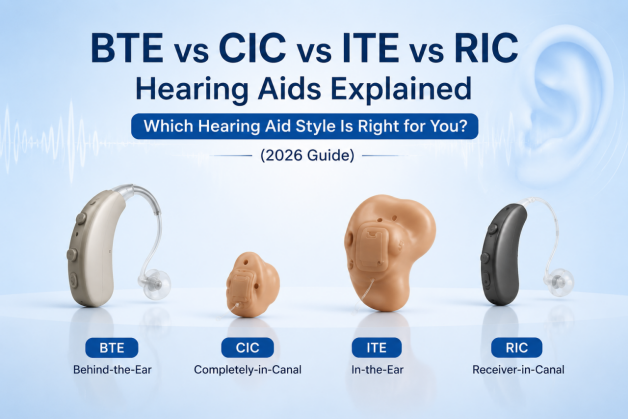
BTE vs. CIC vs. ITE: Which Hearing Aid Style Fits You Best? (2026 Guide)
If you’re shopping for hearing aids across North America or Europe, you’ll quickly get overwhelmed by endless device styles: BTE, CIC, ITC, ITE, RIC. Each design caters to different hearing loss levels, lifestyle needs and cosmetic preferences. Picking the wrong style leads to poor comfort, weak sound amplification or frustrating daily use. Below is a concise breakdown of mainstream hearing aid types, plus our top OTC BTE recommendation — Retekess TE202.
Core Hearing Aid Types: Pros & Cons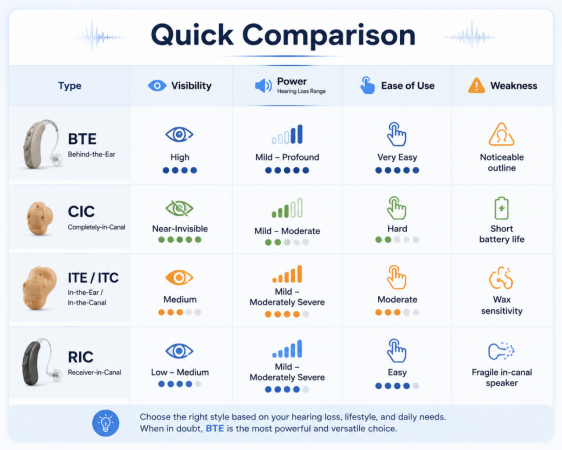
- BTE (Behind-the-Ear)
BTE units rest behind your ear, connected to an earpiece via a thin tube, with all core electronics housed in the outer casing.
Pros: Supports mild to profound hearing loss; large buttons and rechargeable batteries suit seniors with poor dexterity; ample space for advanced algorithms, tinnitus therapy and noise reduction; less vulnerable to earwax damage; long total battery life.
Cons: More visible than in-canal models; microphones pick up more outdoor wind noise; may clash with glasses arms.
Best for: First-time users, moderate-severe hearing loss, elderly users and those prioritizing powerful, low-maintenance performance. - CIC (Completely-in-Canal)
Custom-molded tiny devices fully hidden deep inside the ear canal.
Pros: Nearly invisible; minimal wind noise; natural sound localization.
Cons: Only fits mild to moderate hearing loss; ultra-small batteries drain fast; hard to insert and adjust for people with stiff fingers; prone to earwax breakdown; limited advanced functions like multi-band noise suppression.
Best for: Young users with mild hearing loss who value absolute discretion and have steady fine motor skills. - ITC/ITE (In-the-Canal / In-the-Ear)
Medium-sized custom devices sitting partially in the ear bowl, a middle ground between CIC and BTE.
Pros: More concealed than BTE, easier to operate than CIC; slightly longer battery life than fully canal styles.
Cons: Still susceptible to wax clogging; cannot deliver high amplification for severe hearing loss; custom molds may need replacement as ear shapes change with age. - RIC (Receiver-in-Canal)
Similar to BTE but with a tiny speaker placed inside the ear canal via thin wire.
Pros: Slimmer outline than traditional BTE; less plugged-up occlusion effect.
Cons: In-canal receivers easily get blocked by earwax; insufficient power for profound hearing loss.
Quick Comparison Cheat Sheet
|
Style |
Visibility |
Hearing Loss Range |
Ease of Use |
Core Weakness |
|
BTE |
High |
Mild – Profound |
Very Easy |
Noticeable outline |
|
CIC |
Near-Invisible |
Mild – Moderate |
Hard |
Short battery life |
|
ITC/ITE |
Medium |
Mild – Moderately Severe |
Moderate |
Wax sensitivity |
|
RIC |
Low-Medium |
Mild – Moderately Severe |
Easy |
Fragile in-canal speaker |
How to Narrow Down Your Choice
Three simple questions cut through decision fatigue for EU and US OTC buyers:
- Hearing loss severity: Severe loss rules out CIC and most RICs; BTE is your safest powerful option.
- Dexterity level: If you struggle with tiny objects, skip CIC entirely and choose rechargeable BTE.
- Daily scenarios: Frequent outdoor walks, restaurant dining or tinnitus symptoms require advanced noise reduction and sound therapy, features almost exclusively found on premium BTE devices.
Across Europe and North America, BTE hearing aids dominate the OTC market for one clear reason: they balance affordability, full functionality and user-friendly design for most hearing-impaired adults.
Top OTC BTE Pick: Retekess TE202
If BTE matches your needs, the Retekess TE202 digital hearing aid stands out among budget-friendly OTC options for EU and US customers.
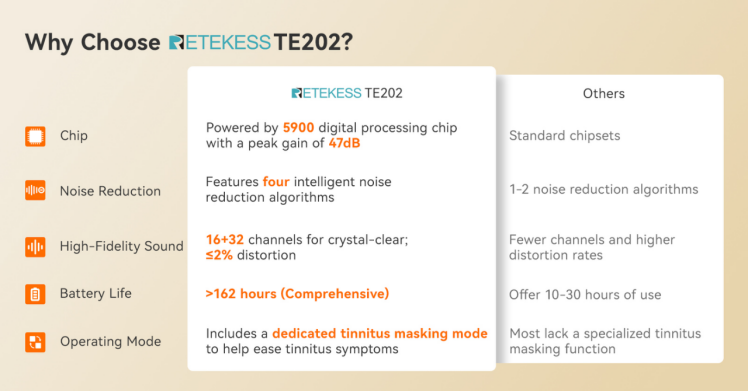
Powered by the onsemi 5900 digital chip, it delivers millisecond-level sound analysis with 16 WDRC compression channels and 32 independent ED environment detection channels — far higher configuration than competing OTC devices. Four built-in proprietary algorithms handle all common audio disturbances: adaptive noise suppression clarifies speech amid background chatter; feedback elimination stops annoying whistling without sound cuts; 1ms transient strong sound blocking caps sudden loud noises (car horns, slamming doors) at safe 70dB SPL to protect residual hearing; dedicated wind noise filtering fixes the classic BTE wind interference issue.
For users living with tinnitus, the built-in sound therapy system plays gentle white noise to relieve ringing sensations long-term. Practical design highlights include a magnetic charging case offering up to 80 hours total runtime, eliminating frequent battery replacements. The 10-second delayed startup prevents sharp squeals while putting on the device, and IP65 dust/water resistance lets you wear it safely in light rain. With 6 adjustable volume gears and 45dB peak gain, it covers most mild to moderately severe hearing loss cases. Its ergonomic non-slip ear tube fits all-day wear comfortably.
Final Verdict
No single hearing aid style works for everyone. CIC suits discretion-focused light hearing loss users, while RIC and ITC are compromise options for mild-moderate impairment. For first-time buyers, seniors or anyone needing robust amplification and full feature sets, a well-engineered BTE like Retekess TE202 delivers the best overall value for European and American OTC shoppers.
If you’re tired of struggling to follow conversations in crowds or enduring uncomfortable, underpowered hearing devices, Retekess TE202 offers accessible, professional-grade digital hearing support with fast shipping across the US and Europe.

Comments
There are no customer reviews yet . Leave a Reply !
Leave a Reply