
Do You Need a Hearing Test? 5 Real-Life Signs You Are Not Just "Getting Older"
You miss the punchline of a joke at dinner. Your spouse complains you turn the TV up too loud. You let phone calls go to voicemail because listening feels like work. Everyone mumbles these days, right?
Hearing loss develops so gradually that most people do not notice it for years. You adapt. You read lips. You nod and laugh when you think you should. You blame other people for not speaking clearly. But there are specific, predictable signs that go beyond normal aging. If you recognize yourself in two or more of these, it is time for a hearing test.
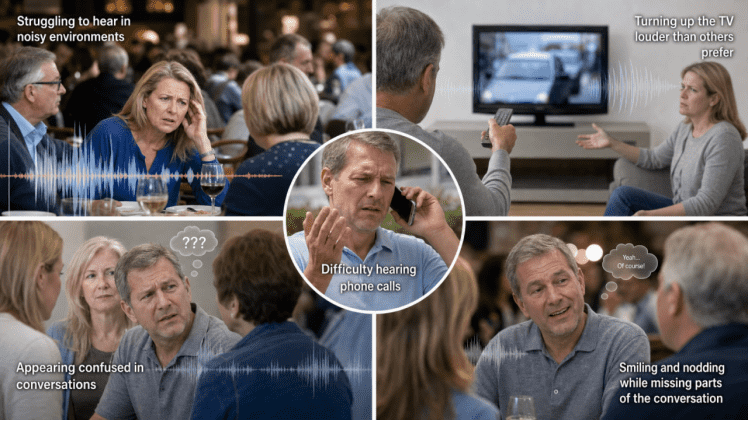
Sign 1: You Can Hear People Talking, But You Cannot Understand What They Are Saying
This is the #1 most common early sign of hearing loss, and it is almost always missed. People say, "My hearing is fine—I can hear people talking." But hearing sound and understanding speech are two different things.
High-frequency hearing loss, the most common age-related and noise-induced type, hits the consonant sounds first: s, f, th, sh, k, p. Vowels are low-frequency and remain clear. This creates that frustrating experience where you hear someone talking, but it sounds like they are mumbling.
Real-life examples:
- You constantly ask people to repeat themselves, especially women and children (their voices are higher pitched)
- You find yourself leaning in or turning your "good ear" toward people when they talk
- You mishear words: "cat" sounds like "cap," "show" sounds like "so," "three" sounds like "free"
- Phone conversations are particularly hard because you cannot see lips or facial expressions
This is not "people mumbling." It is the first sign that high-frequency sounds are not reaching your brain the way they should.
Sign 2: Restaurants and Parties Are Exhausting
Healthy hearing automatically filters background noise and focuses on the voice in front of you. When hearing loss damages this ability, your brain has to work overtime to separate speech from clinking glasses, other conversations, music, and kitchen noise.
Real-life examples:
- You leave restaurants or family gatherings feeling mentally drained, even if you had a good time
- You start avoiding group dinners or parties because following conversations feels like work
- You find yourself watching people's lips intently instead of making eye contact
- You cannot follow conversations when more than one person talks at a time
- You sit in the same seat at church or meetings because you know it is easier to hear there
NYU Langone otolaryngologists note that this difficulty in noise often appears years before people notice problems in quiet environments. It is the earliest detectable sign of clinically significant hearing loss.
Sign 3: Everyone Complains Your Volume Is Too High
Volume creep happens so slowly you do not notice it. Your brain adapts to what feels "normal," and you turn things up a little at a time until other people point it out.
Real-life examples:
- Your spouse or kids complain the TV is too loud, but it sounds fine to you
- People in the next room can hear your TV or phone
- You need car radio volume at levels that passengers complain about
- You cannot hear the doorbell, timer on the oven, or turn signal in the car
- You hold your phone on speaker because you cannot hear it on the normal ear setting
If multiple people have commented on your volume levels across different devices, that is not them being sensitive. That is a consistent sign your hearing has changed.
Sign 4: You Start Withdrawing Without Realizing It
Hearing loss is invisible, and the social changes happen gradually. You do not wake up one day and decide to stop socializing. It happens one small avoidance at a time.
Real-life examples:
- You let unknown numbers go to voicemail and sometimes avoid calls from friends too
- You decline invitations to restaurants or parties that you would have enjoyed a few years ago
- You smile and nod during conversations instead of asking people to repeat themselves because you do not want to be a burden
- You feel anxious before group events because you know listening will be hard
- You leave conversations early because it is too tiring to keep up
- People tell you that you seem "quiet" or "distant" lately
Research published in The Laryngoscope found that people with even mild hearing loss are significantly more likely to report loneliness and social withdrawal. This is not a personality change—it is a natural response when communication becomes effortful.
Sign 5: You Have Ringing, Buzzing, or Fullness in Your Ears
Tinnitus—that ringing, buzzing, hissing, or clicking sound in your ears—is not just an annoyance. It is almost always a sign of inner ear damage, and it frequently appears before you notice measurable changes in hearing.
Real-life examples:
- You hear ringing when it is quiet at night, even if it goes away during the day
- You have constant or intermittent buzzing that no one else can hear
- Your ears feel full or "plugged" even when you do not have a cold
- You have episodes where sounds seem muffled for hours or days at a time
- You find it harder to tell where sounds are coming from
Tinnitus does not have a cure, but hearing aids with built-in tinnitus masking (like the Retekess TE202 BTE) provide significant relief for most people by amplifying environmental sound and delivering neutral sound therapy that reduces tinnitus perception.
Red Flags That Require Immediate Medical Attention
Most hearing loss develops gradually and is not a medical emergency. But see a doctor right away if:
- Hearing loss happens suddenly in one or both ears
- Hearing loss comes with vertigo, dizziness, or balance problems
- You have ear pain, drainage, or bleeding along with hearing loss
- Hearing loss is significantly worse in one ear than the other
- You hear a pulsing sound that matches your heartbeat
These can be signs of treatable medical conditions that need attention beyond just hearing aids.

The 60-Second Self-Test
Answer these quick questions. If you answer "yes" to three or more, schedule a hearing test:
- Do people seem to mumble more than they used to?
- Do you have trouble understanding conversations in restaurants?
- Do you turn the TV or radio up louder than other people prefer?
- Do you frequently ask people to repeat themselves?
- Do you have trouble hearing women or children's voices?
- Do you feel tired after social gatherings from concentrating so hard?
- Do you hear ringing or buzzing in quiet environments?
- Do you avoid phone calls because listening is hard?
What to Do Next
If you see yourself in these signs, do not wait. The average person waits 7-10 years after first noticing difficulty before getting help. During that time:
- Your brain loses practice processing certain sounds, making adaptation harder when you finally get devices
- Social connections fray from missed conversations and avoidance
- Research links unaddressed hearing loss to higher dementia risk, fall risk, and depression
You have options that did not exist even five years ago. You can get a professional audiogram through an audiologist, or you can try affordable FDA-registered OTC hearing aids and see if they help. Devices like the Retekess TE201 RIC or TE202 BTE provide digital sound processing, noise reduction, and rechargeable convenience at price points that make trying them low-risk.
The worst thing you can do is nothing. Hearing loss does not get better on its own, but it is extremely treatable. The first step is simply acknowledging the signs.

Comments
There are no customer reviews yet . Leave a Reply !
Leave a Reply