
From Analog to Digital: A Decade of Evolution in Hearing Aid Technology
If you tried hearing aids a decade ago and put them in a drawer forever, you are not alone. Millions of people tried the devices of the 2010s and found them uncomfortable, tinny, whistling, expensive, and more trouble than they were worth. The good news: hearing aid technology changed more in the past 10 years than in the previous 50. If you wrote them off years ago, 2026 is the time to try again.
What Hearing Aids Were Like in 2016
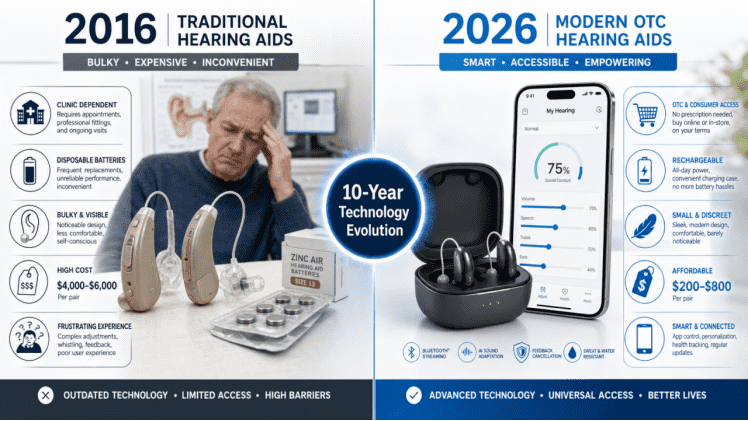
Let us start with what you probably remember:
- $4,000-$6,000 per pair, sold only through audiology clinics with huge markups
- Disposable batteriesthat died every 5-7 days, requiring constant replacements
- Feedback that whistledevery time you put a phone near your ear or hugged someone
- Clunky BTE designsthat were obvious to everyone
- One-size-fits-all programmingthat made everything louder but not necessarily clearer
- Multiple office visitsjust to get volume adjusted
- No connectivity—they were just amplifiers, nothing smart
- Tinnitus cost extraif it was available at all
- No returnsonce you bought them, or steep restocking fees
Worst of all, many devices from that era amplified background noise as much as speech, making restaurants and social gatherings worse instead of better. It is no wonder so many people gave up on them.
The 2022 OTC Ruling Changed Everything
The single biggest shift happened October 17, 2022, when the FDA finalized the over-the-counter hearing aid rule. After years of bipartisan work starting with Senators Grassley and Warren's 2017 legislation, adults 18+ with mild-to-moderate hearing loss could suddenly buy hearing aids directly—no doctor visit, no prescription, no mandatory audiologist appointment.
This did not just make them easier to buy. It broke the clinic monopoly that had kept prices artificially high for decades. New direct-to-consumer brands entered the market, and prices dropped 70-80% for comparable technology.
In 2016, a "budget" hearing aid was $1,500 per pair and still required a clinic visit. In 2026, you can buy FDA-registered, fully digital hearing aids with better technology than 2016's premium models for $200-$800, delivered to your door, with 30-90 day trial periods.
The Technology Improvements That Actually Matter
You can ignore the marketing fluff about "AI" and "revolutionary sound." These are the concrete improvements that make 2026 hearing aids actually usable compared to a decade ago:
1. Digital Noise Reduction Actually Works
2016-era digital aids had basic noise reduction that mostly just turned everything down in loud environments. Modern devices use multi-channel processing that identifies speech patterns and separates them from background noise in real time.
The Retekess TE202, for example, runs four separate noise reduction algorithms simultaneously. This is not marketing speak—it means you can actually follow a conversation in a restaurant without everything sounding like a garbled mess. It is not perfect, but it is night-and-day better than even 2018's premium devices.
2. Feedback Cancellation Actually Stops Whistling
That high-pitched squeal that used to happen every time you put a phone to your ear? Modern feedback cancellation uses phase cancellation to stop whistling before you hear it. You can hug your grandkids, wear hats, and hold phones to your ear without that embarrassing squeal.
3. Rechargeable Batteries Are Now Standard
Gone are the days of fumbling with tiny batteries every week, carrying spares everywhere, and having a device die mid-conversation. Modern lithium-ion rechargeable hearing aids last 80-160 hours on a single charge. The Retekess TE202 runs 162 hours—over a week of typical use—between charges. You put them in the charging case overnight, and they are ready to go in the morning. No more buying 100+ batteries per year.
4. They Are Actually Discreet
In 2016, "invisible" hearing aids were a premium upsell that cost extra and had terrible battery life. Now, completely-in-canal (CIC) models like the Retekess TE103 sit entirely inside your ear canal. Nobody standing right next to you will see them. Even BTE models are smaller, slimmer, and available in skin tones that blend with hair and skin.
The stigma that kept people from getting help is largely gone, especially since OTC availability normalized hearing aids as consumer electronics rather than "old person medical devices."
5. App Control Means No More Office Visits
Remember having to schedule an appointment and drive to the audiologist just because volume was too high in one ear? Now you can adjust volume, switch programs, and even fully self-fit your hearing aids from your phone. The Retekess TE103 connects via the SOUNDWEAR app, letting you create custom profiles for different environments without ever leaving your house.
6. Tinnitus Masking Is Built In
Ten years ago, if you had tinnitus along with hearing loss, you needed a separate, expensive tinnitus device or paid thousands extra for the feature. Now tinnitus masking is standard in most mid-range devices. The TE202 includes a dedicated tinnitus sound therapy system that plays neutral, soothing sound to reduce ringing perception.
7. They Connect to Your Phone
Bluetooth hearing aids existed in 2016, but they were premium $5,000+ devices that only worked with specific phones. Now even budget devices stream calls, music, and podcasts directly from your phone, functioning like wireless earbuds that also correct your hearing.
8. Trial Periods and Returns
In 2016, you bought hearing aids and you were stuck with them (minus perhaps a 30-day trial with a large restocking fee). Now, almost every OTC brand offers 30-90 day risk-free trials. You can wear them in your actual life—in restaurants, at family gatherings, at work—and return them if they do not work for you.
What Has Not Changed
It is not all perfect. A few things remain the same:
- You still need an adjustment period. Your brain needs weeks to re-learn how to process amplified sound. The devices are better, but the neurology of adaptation has not changed.
- Severe to profound hearing loss still requires prescription devices from an audiologist. OTC aids work for mild-to-moderate loss, which covers about 80% of people with hearing difficulty.
Perfect speech in noise is still hard. Even the best hearing aids cannot completely isolate a single voice in a crowded room. But they are much, much better than they used to be.

Should You Try Again?
If you tried hearing aids before 2020 and gave up, the answer is almost certainly yes. The combination of lower prices, better technology, rechargeable convenience, discreet designs, and no-risk trials makes this a completely different product category than what you remember.
Start with an affordable, well-reviewed OTC model from a reputable brand. Look for:
- Real digital processing (not just analog amplifiers)
- Rechargeable batteries
- Multiple listening programs
- Good return policy
- FDA registration
The biggest cost of waiting is not financial. Unaddressed hearing loss leads to social isolation, depression, cognitive decline, and fall risk. People who get hearing aids report better relationships, more confidence, less mental fatigue, and higher quality of life. The devices you tried a decade ago were not good enough to deliver those benefits. The devices available today are.
Sources:
- S. FDA, Over-the-Counter Hearing Aid Final Rule, August 2022
- Knowles, "OTC Hearing Aids: Reflecting on the Evolution of Hearing Technology," 2023
- Frontiers in Audiology and Otology, "Over-the-counter hearing aids: implementations and opportunities," 2024
- Hearing Industries Association, MarkeTrak Adoption Surveys
National Council on Aging, Hearing Aid User Satisfaction Data

Comments
There are no customer reviews yet . Leave a Reply !
Leave a Reply