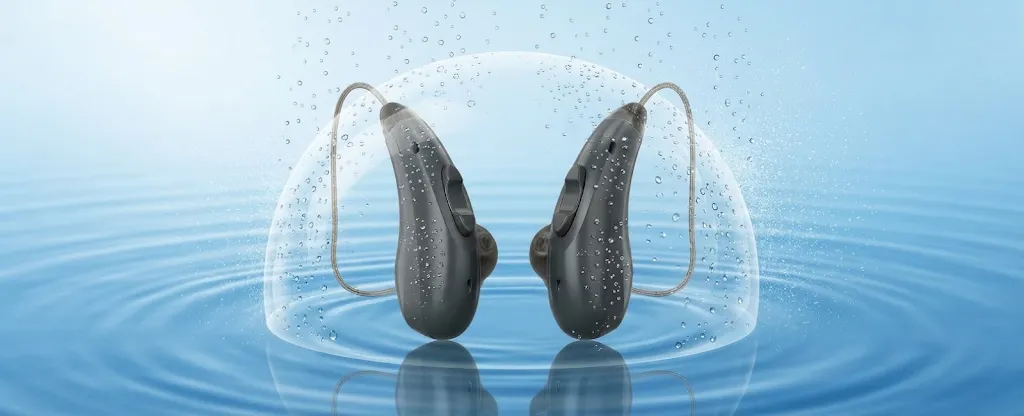
How to Protect Your Hearing Aids from Sweat, Rain, and Moisture: A Guide to IP Ratings
Hearing aids are designed to support your daily listening needs, but everyday life doesn’t always take place in a dry, comfortable environment.
From morning walks and outdoor activities to hot weather, perspiration, and unexpected rain, hearing aids can be exposed to moisture in a variety of ways. For those who wear their hearing aids all day, resistance to water and dust is a crucial factor when choosing the right hearing solution.
But exactly what level of protection do you need?
Are water-resistant hearing aids suitable for people who sweat frequently? Can they be worn in the rain? What is the difference between an IP68-rated hearing aid and an IP65 model?
-
Common Situations in Daily Life That Can Expose Hearing Aids to Moisture
Many people associate water damage to electronic devices with dropping them into a sink or a swimming pool. However, hearing aids can be exposed to moisture long before such an accident occurs.
Consider the following common scenarios:
Perspiration during exercise and daily activities: Even moderate physical activity can cause sweating around the ears. Walking, gardening, household chores, and outdoor sports can all lead to your hearing aids coming into contact with sweat. Repeated exposure to moisture can damage electronic components, especially if the device has limited environmental protection.
Rain and sudden changes in weather

High humidity and damp environments
Moisture is not always visible to the naked eye. High humidity, perspiration, and temperature fluctuations can cause condensation or moisture buildup around the internal components of your hearing aids.
This is one of the reasons why—even with a high IP rating—regular maintenance and proper storage remain essential. Dust and Everyday Particles
Outdoor environments can expose hearing aids to dust, dirt, and fine particles.
These particles may accumulate around microphones, receivers, openings, or charging contacts. Dust-protection measures can help reduce the risk of particles entering sensitive areas, but regular cleaning remains essential.
-
What level of water resistance do hearing aids need?
When comparing hearing aids, you may encounter terms such as "water-resistant," "sweat-resistant," "splash-proof," and "IP68."
These terms are not interchangeable.
The IP (Ingress Protection) rating, defined by the IEC 60529 standard, provides a standardized method for describing how an enclosure protects against the entry of solid foreign objects and water under specific test conditions.
For those choosing hearing aids, it is particularly important to understand the following ratings:
IPX5: Indicates that the device has passed a test for protection against water jets. The "X" signifies that no specific rating has been assigned for protection against solid particles.
IP24: Offers protection against objects 12.5 mm or larger in diameter (under specific conditions) and provides basic protection against water splashes from any direction.
IP65: Dust-tight and protected against water jets. This rating combines protection against dust ingress with resistance to water projected from a nozzle—useful for electronic devices exposed to dusty environments or certain wet conditions. However, an IP65 rating does not provide protection against immersion in water.
IP68: Dust-tight and capable of withstanding immersion in water under specific conditions. The TE105 RIC hearing aid offers comprehensive protection against sweat, splashes, and light-to-moderate rain (defined by international meteorological standards as rainfall up to 7.6 mm/hour or 0.30 inches/hour).
Note: If the device is exposed to rain, wipe the microphone openings dry with a soft cloth to ensure clear sound quality. Do not submerge the device in water for extended periods.
-
Is a higher IP rating always better for hearing aids?
While a higher IP rating does offer greater protection, the ideal specification for you depends on how and where you use your hearing aids.
Consider the following everyday scenarios:
 Your Daily Activities
Factors to Consider
Primarily indoor activities
Basic protection and routine maintenance
Frequent outdoor activity
Protection against sudden rain and environmental particles
Regular physical exercise
Moisture resistance and sweat management
Dusty outdoor environments
A specific dust-resistance rating
Concern regarding accidental water exposure
An appropriate level of water-immersion protection (e.g., IP68)
For those who wear their hearing aids all day, an IP68 rating is an attractive feature, as it provides complete protection against dust and a defined level of protection against water immersion.
However, this should not be the only factor in your decision-making. Sound quality, fitting flexibility, wearing comfort, and after-sales support are equally important.
-
Five Practical Ways to Keep Your Hearing Aids in Good Condition
Even with a high IP rating, hearing aids still require proper care. While water resistance provides protection, it is not a substitute for routine maintenance.
- Clean your hearing aids regularly
Use the cleaning tools recommended by the manufacturer to remove visible earwax and debris.
Pay special attention to the ear tips, receiver openings, and microphone areas.
Avoid using sharp objects or applying excessive force, which could damage delicate components.
- Keep charging contacts clean and dry
The accumulation of moisture, dust, or debris around the charging contacts can interfere with the charging process.
Before placing your hearing aids into the charging case, ensure the contacts are clean and follow the manufacturer’s instructions for keeping them dry.
- Follow recommended drying procedures
If you sweat frequently or live in a humid environment, regular drying helps maintain your hearing aids.
Use a drying solution approved by the manufacturer when necessary. Do not assume that an IP68 rating allows you to neglect routine maintenance. 4. Inspect Ear Tips and Protective Components
Ear tips, seals, and other protective components are subject to wear and tear over time.
Please inspect these parts regularly and replace them as recommended. If components are damaged or improperly installed, it may compromise both wearing comfort and the device's protective performance.
- Avoid Unnecessary Exposure to Moisture
Being water-resistant does not mean the hearing aid can be exposed to moisture indiscriminately.
Unless explicitly permitted by the manufacturer, avoid wearing your hearing aids while swimming or showering, and do not use them in environments where they might come into contact with soap, shampoo, salt water, or other chemical substances.
-
Why Consider RIC Hearing Aids?
While protective performance is important, wearing comfort and auditory performance are equally significant.
RIC stands for "Receiver-in-Canal." In this design, the main body of the hearing aid sits behind the ear, while a tiny receiver is placed inside the ear canal.
Compared to some "Completely-in-Canal" (CIC) designs, RIC hearing aids offer a different balance between comfort, functionality, and flexibility.
RIC hearing aids can be paired with various types of ear tips, including "open-fit" styles.
When a user's hearing profile allows for an open-fit configuration, this design enables more natural low-frequency sounds to enter the ear canal, helping to reduce the "occlusion effect"—a sensation of stuffiness caused when the ear canal is completely blocked.
-
Introducing the Retekess TE105: A Smart RIC Hearing Aid with an IP68 Rating

For users who seek advanced sound customization and wireless connectivity, alongside dust and water resistance, the Retekess TE105 smart RIC Bluetooth hearing aid combines a range of practical features.
Priced at $399.99, the TE105 is designed for individuals with moderate to severe hearing loss. For users who are frequently outdoors or desire an extra layer of protection against accidental exposure to moisture, an IP68 rating is a significant feature worth noting.
Intelligent Speech Tracking for Everyday Conversations
Following a conversation can be challenging when multiple people are speaking at once or when background noise interferes with speech.
The TE105 incorporates intelligent speech tracking and speech enhancement features, designed to help users focus on conversations while effectively managing ambient noise.
Four adjustable sound control bands offer precise customization options:
Noise suppression
Speech enhancement
Impulse noise (sudden, sharp sounds) suppression
Wind noise suppression
These settings allow users to flexibly tailor their listening experience based on their personal preferences and specific environments.
The TE105 utilizes 16-channel Wide Dynamic Range Compression (WDRC) digital signal processing.
WDRC dynamically adjusts the level of amplification based on the volume and frequency range of incoming sounds, providing a more accurate and personalized output compared to simple, fixed-volume amplification.
Additionally, the TE105 supports in-app hearing tests, self-adjustment, the import of existing audiograms, and independent settings for the left and right ears.
This provides users with greater flexibility when customizing their hearing profile.
Bluetooth Connectivity and Tinnitus Masking
The TE105 supports Bluetooth connectivity with compatible mobile phones and televisions. It also includes a "Tinnitus Relief Mode," offering a sound-based solution for those seeking assistance with tinnitus.
Ongoing Post-Purchase Support
Selecting a hearing aid is an ongoing process, not just a one-time purchase.
Retekess provides the following support for the TE105:
60-day free trial: Allows you to experience the device firsthand in your daily listening environment.
3-year warranty: Provides added product protection (please refer to the specific terms and conditions).
Lifetime technical support: Assistance with device setup, operation, and answers to any technical questions.
These services are designed to help you adapt to your new hearing aid with greater ease.
-
Who should consider the Retekess TE105? If the following points apply to you, consider the TE105:
You are looking for a RIC (Receiver-in-Canal) hearing aid with an IP68 rating (dust-tight and capable of withstanding immersion under specific conditions).
You engage in frequent outdoor activities and require robust environmental protection.
You prefer to conduct hearing tests and personalize your sound settings via a mobile app.
You need intelligent speech-tracking features and a variety of listening modes.
You require Bluetooth connectivity with compatible devices.
You value a long trial period and ongoing technical support.
Frequently Asked Questions About Water-Resistant Hearing Aids
Are IP68-rated hearing aids completely waterproof?
They offer comprehensive protection against sweat, splashes, and light-to-moderate rain (defined by international meteorological standards as rainfall up to 7.6 mm/hour or 0.30 inches/hour).
Can I wear an IP68-rated hearing aid while showering?
No. Exposure to soap, shampoo, hot water, and water pressure exceeds the protective limits for which the device has been tested.
Are water-resistant (or water-repellent) hearing aids suitable for people who sweat a lot?
Hearing aids with an appropriate water-resistance rating provide a degree of protection against moisture. However, an IP rating alone does not guarantee sweat-proofing. Regular cleaning, drying, and maintenance remain essential.
Does an IP68 rating improve the sound quality of a hearing aid?
No. An IP68 rating describes the protective capabilities of the casing, not its acoustic performance. Sound quality depends on various factors, such as receiver performance, signal processing, the precision of the fitting, frequency response, and the user's individual hearing needs.
Is the Retekess TE105 suitable for daily outdoor use?
The TE105 combines an IP68-rated design with Bluetooth connectivity, speech-tracking technology, and multiple listening modes. Provided that the user follows the provided operation and maintenance guidelines, it is an excellent choice for daily use.

Comments
There are no customer reviews yet . Leave a Reply !
Leave a Reply