WDRC vs. Linear Amplification in Hearing Aids: What's the Difference?
If you are comparing hearing aids, you may come across terms that sound technical but matter a lot in everyday listening. Two of the most important are WDRC and Linear Amplification. Both are ways of making sound louder, but they do it in very different ways. And that difference can affect how natural, comfortable, and useful a hearing aid feels in real life.
For many people, the key question is not just, “Can this device make sound louder?” It is also, “Will it make speech easier to understand?” and “Will it still feel comfortable when sounds change from quiet to loud?” That is where amplification style becomes important.
In this article, we’ll explain what WDRC and Linear Amplification mean, how they differ, and why the choice between them can shape your listening experience.
What Linear Amplification Means
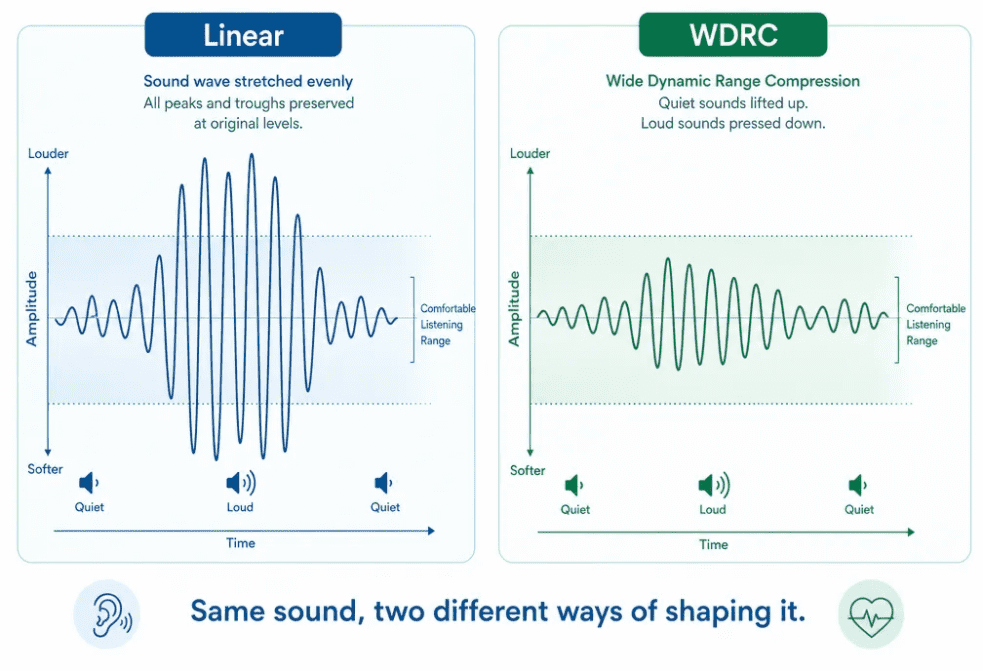
Linear amplification is the simplest way to make sound louder. The hearing aid picks up sound through a microphone, runs it through an amplifier, and pushes it into the ear at a fixed gain.
If a whisper comes in at 30 decibels, the aid boosts it by, say, 40 decibels. The whisper arrives at 70 decibels, the level of normal conversation. If a door slams at 90 decibels, the same 40-decibel boost pushes it to 130 decibels, which is close to the threshold of pain.
The math is even. Every sound gets the same amount of help. This is how the first generation of hearing aids worked, and it is how most over-the-counter sound amplifiers still work today.
|
Strength |
Weakness |
|
1. Simple Design: Fewer components and a simpler amplification approach. 2. Lower Cost: Generally less expensive. 3. Natural Sound: Preserves the original dynamic range of music and voices, keeping soft sounds soft and loud sounds loud. |
4. Soft Sounds May Be Missed: Quiet sounds can get lost in background noise. 5. Loud Sounds Can Be Uncomfortable: Amplifying all sounds equally may make already loud sounds too loud. 6. Limited Adaptation: Applies the same level of amplification to all sounds, rather than giving more boost to soft sounds and less to loud sounds. |
What WDRC Means
WDRC stands for Wide Dynamic Range Compression. It is the approach modern digital hearing aids use instead of linear amplification. You can think of WDRC as a more adaptive listening strategy. Instead of amplifying everything in the same way, it changes how sound is processed based on the level of the input. This helps create a more balanced and natural listening experience.
In real life, this matters a lot. Not all sounds are equally important. A voice may be too soft to hear clearly, while another sound may be loud enough to become uncomfortable. WDRC tries to manage that range so the listener can hear more of what matters without being overwhelmed.
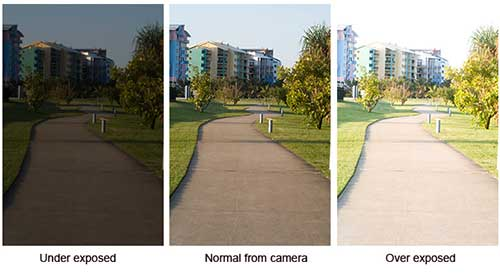
Think of it like a photographer adjusting exposure. In a bright room, the camera reduces sensitivity so the sky does not blow out. In a dark room, it increases sensitivity so shadows become visible. WDRC does the same thing with sound. Soft sounds get more gain. Loud sounds get less gain. The goal is to fit the wide range of the outside world into the narrow range the impaired ear can actually use.
The Side-by-Side Comparison
|
Item |
Linear Amplification |
WDRC |
|
How it works |
Fixed gain for all sounds |
More gain for soft sounds, less for loud |
|
Soft voices |
Often lost in noise |
Boosted into audible range |
|
Loud sounds |
Arrive at full boosted level, can be painful |
Compressed to a comfortable range |
|
Music |
Natural, keeps dynamic contrast |
Can sound flatter if over-compressed |
|
Cost |
Simpler hardware, lower price |
More processing, higher price |
|
Best fit |
Mild hearing loss, music listeners |
Mild to severe loss, everyday conversation |
Here is the difference in one sentence. A hearing aid with linear amplification turns the volume up by a fixed amount. A hearing aid with WDRC turns soft sounds up a lot and loud sounds up a little, or not at all.
Why Linear Amplification Has Not Disappeared
It is easy to think of linear amplification as the old technology and WDRC as the new one. Not quite.
Who still benefits from linear:
- People with mild hearing loss, who can already follow most conversations and only struggle in very noisy rooms
- Musicians and music listeners who want the soft-loud contrast of a recording to stay intact
- Budget buyers who want a simple over-the-counter amplifier without the cost of a digital aid
Linear amplification sounds natural because it does not reshape the dynamic range. A piano pianissimo stays soft. A cymbal crash stays loud. That is why over-the-counter personal sound amplification products, or PSAPs, still use it.
Why Most People Need WDRC
For anyone with mild to moderate hearing loss, the problem is not that everything is too quiet. The problem is that soft sounds have disappeared from the range they can hear.
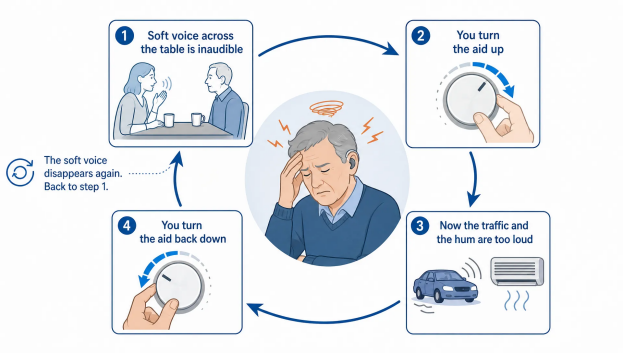
Linear amplification does not fix this. It turns the whisper up to normal volume, which is good, but it also turns the traffic up to painful volume, which is bad. The wearer ends up turning the whole device down to make the traffic tolerable, and then the whisper disappears again.
WDRC breaks that loop. The whisper gets the boost. The traffic does not. The wearer can hear the dinner conversation without the room becoming uncomfortable.
Two Things People Get Wrong
"WDRC turns loud sounds off."
No. A 90-decibel clap still arrives at a comfortable 80. You hear it. You just do not flinch. WDRC limits the boost. It does not silence the world.
"Linear amplification is always worse."
No. It is a different tool for a different problem. If your hearing loss is mild and you mostly listen to music at home, linear may serve you fine. If you need to follow conversation in restaurants and cars every day, WDRC is the better fit.
How to Choose
Ask yourself three questions. They cover the main hearing aid amplification types and narrow down the right fit.
- How loud is your hearing loss?Mild loss can often start with linear or a PSAP. Moderate to severe loss usually needs WDRC, because the dynamic range is too narrow for fixed gain to work.
- Where do you struggle most?Restaurants, cars, and noisy rooms point to WDRC. Television at home and recorded music point to linear or light compression.
- Can the aid switch between modes?A device that stays in heavy compression everywhere will feel muffled at a concert. The best aids let you choose a lighter mode for music and a stronger mode for noisy rooms.
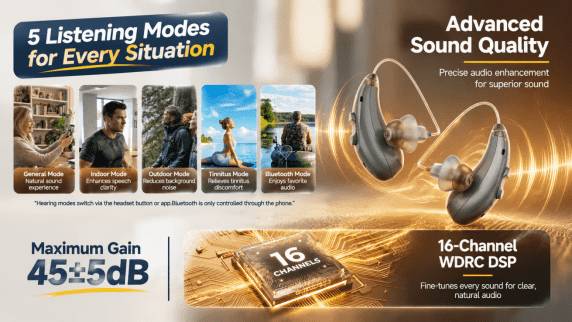
The Retekess TE105 RIC hearing aid is built around this idea. It uses multiple independent frequency channels, each with its own WDRC compression, plus separate settings for steady background noise, wind, and impulse sounds. The wearer shifts the processing based on the room. The aid does not flatten the world into one fixed volume.
The Bottom Line
WDRC and Linear Amplification both aim to make hearing easier, but they do it in very different ways. WDRC is more adaptive and helps manage a wider range of sound levels. Linear amplification is more direct and consistent.
If your priority is a more balanced and natural listening experience, WDRC is often the more flexible option. If you prefer a simpler amplification style, linear amplification may still be worth considering.
Understanding the difference between these two approaches can help you make a more informed choice when comparing hearing aids. After all, the best hearing aid is not just the one that makes things louder. It is the one that makes listening feel clear, comfortable, and manageable in real life.
If you want to understand hearing aid performance more clearly, please contact us for free consultment.

Comments
There are no customer reviews yet . Leave a Reply !
Leave a Reply